 Telescopic view of Gypsum Sand grains. 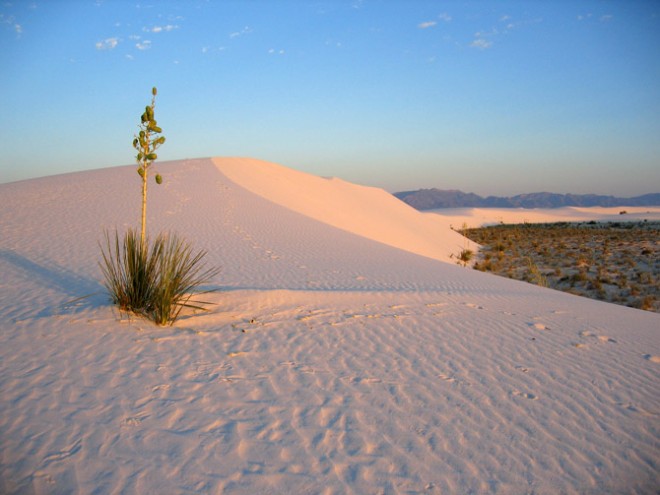 Sand dunes: Always advancing, at dune's leading
edge the sand builds up until gravity pulls it down slip face and moves
the dunes forward. | Geologic History of the White Sands
The sands were derived from marine rocks in the Permian Sea throughout the Palaeozoic Era (570-245 mya). There was a major fall in sea level due to an unknown cause which formed large quantities of gypsum from the calcium and sulphate concentrations in the sea. As a result, the cycles of evaporation caused hundreds of feet of gypsum to dissolve and settle onto the sea floor. When the Rocky Mountains were formed, the same compressional forces that drove the mountains uplifted the marine rocks. This uplift affected and elevated a broad region, especially Southern New Mexico. The Tularosa Basin, birthplace of the white sands, was formed from a large-scale tectonic event that started 30 mya. Shallow subduction of the California coast ceased and a new parallel-motion plate boundary was formed, which is now represented as the San Andreas Fault. This subduction movement caused magma upwelling to stretch apart large portions of the crust in the southwest forming a large basin and range. As the crust divided, fault zones developed and large blocks of the crust began to subside, forming basins. During the last Pleistocene ice age, the wet climate helped play a major role in the formation of the white sands. The Tularosa Basin was filled with a large lake called, Lake Otero. The heavy rainfall that occurred flushed large quantities of gypsum from San Andreas down to Lake Otero. Overtime, the lake evaporated, leaving behind large amounts of gypsum. Because there is no drainage outlet, the basin traps and concentrates all dissolved gypsum. This dissolved gypsum then begins to crystallize and form selenite crystals. Erosion by wind and water eventually breaks down these crystals into sandy grains of gypsum. It is then carried away from the basin by winds, spreading it among the northern end of the Chihuahuan desert.
|
©Shubh Jagani - SJTours
