Geologic History of the Canadian Rockies The Rocky Mountains began to rise about 75 mya. Scientists are able to measure the age of the sediments and discovered that the Rockies were relatively young. During the Precambrian Era (700mya) the Pacific Ocean covered most western provinces and over the next half billion years the ocean flooded and deposited layers of sand and silt on the ocean floor. Around 550 mya, marine invertebrates and crustaceans died and sank to the ocean floor where they were added to the sediments. Over time the sediments compressed into sandstone, shale and quartzite. This began the formation of the Rocky Mountains. The Rocky Mountains are made up of sedimentary rock consisting of limestone, shale and sandstone. Around 200 mya, the sedimentary rock was collected on a broad and flat seabed under the North America Continental plate. The landmass drifted westward, due to plate tectonics and over the next 40 million years, the western edge of North America drifted far west. As the North American and Pacific Plate collided, the Pacific Plate subducted under the North American Plate which caused the land to crumble and thrust upwards. The sedimentary rock on the seabed was pushed upwards, and the main ranges of the Rockies towered above sea level. Over the next 15 million years, the front ranges appeared and the multi-layered seabed shifted into peaks. The Rocks folded and faulted into new layers. 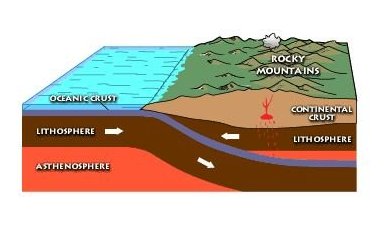 |
Impact of Glaciers Glaciers
can be seen when visiting the Rockies. About two million years ago, the
last ice age caused a huge ice sheet and major glaciations that covered
most of the continent east of the Rockies. A sheet of ice up to 2000m
deep covered all but the highest peak of the mountains. The alpine
icefields and glaciers expanded and carved deep valleys into the
mountains. When the glaciers
retreated, they brought rock and debris down, scraping the sides of the
mountains, making moraines and valleys. The Columbia Icefield feeds up
to eight different glaciers along the continental divide, enjoy a
glacier tour with the two for one package! Diagram of how subduction occured to form mountains.
|
©Shubh Jagani - SJTours
